
Loading
Loading
Where CEOs are born
Anthropic's CEO puts the odds at 70–80% that a one-person company hits a billion dollars this year. In the US alone, more than 117,000 businesses with zero employees already cleared $1 million in revenue in 2023. You run that same model at your scale — a complete digital business you built, sold and automated yourself, in real code, on tools that cost about $0 a month. One clean price, everything included.
One clean price · A mentor who stays until your first paying client · Real code — no templates, no subscriptions
A school, not a course
Your own account, your classroom, your work reviewed by a person, your tools, your numbers. This is the actual platform — not a mockup.
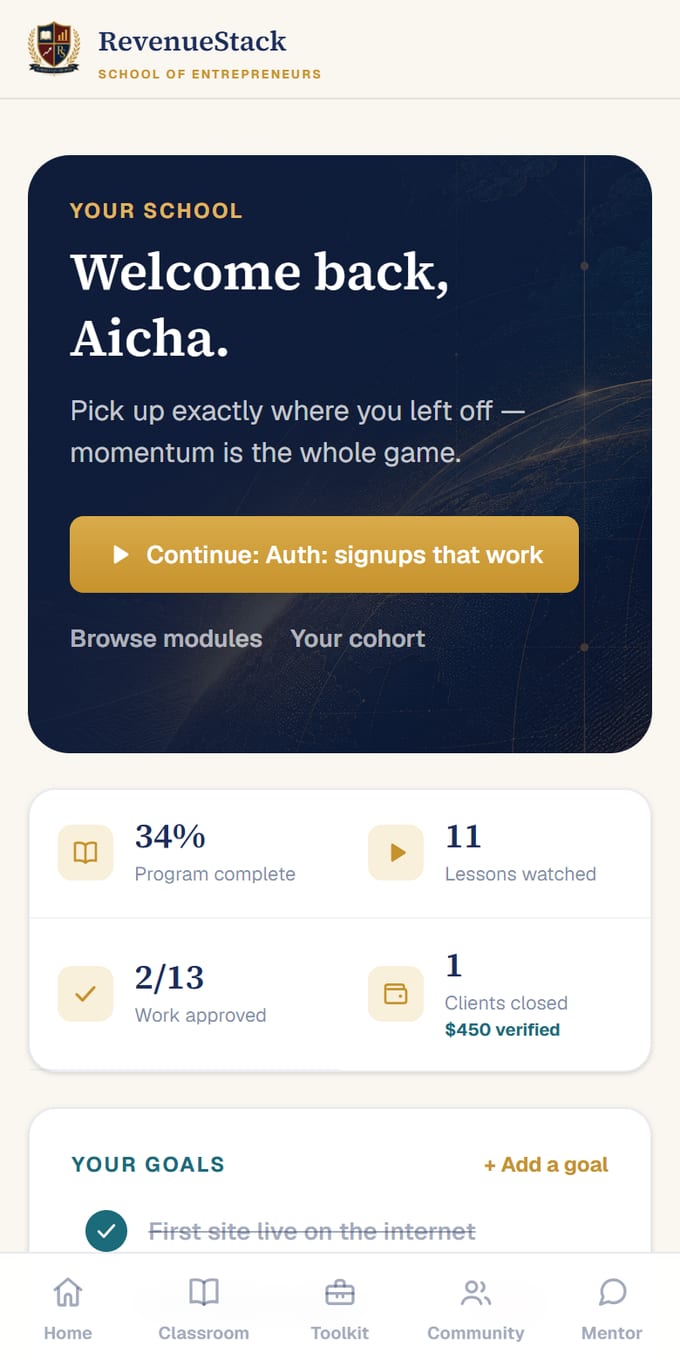
Your dashboard
Progress, goals, clients closed — your business at a glance.
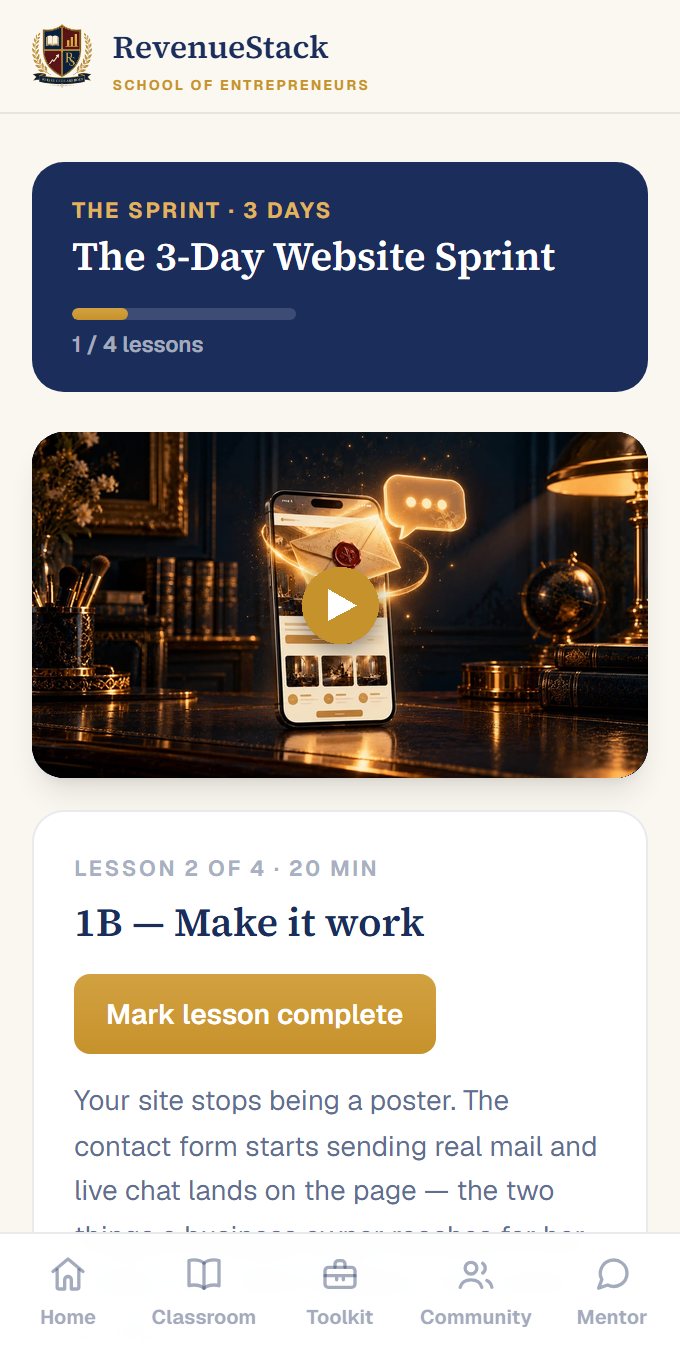
The classroom
Every module a room: lessons, files, and the work it leads to.
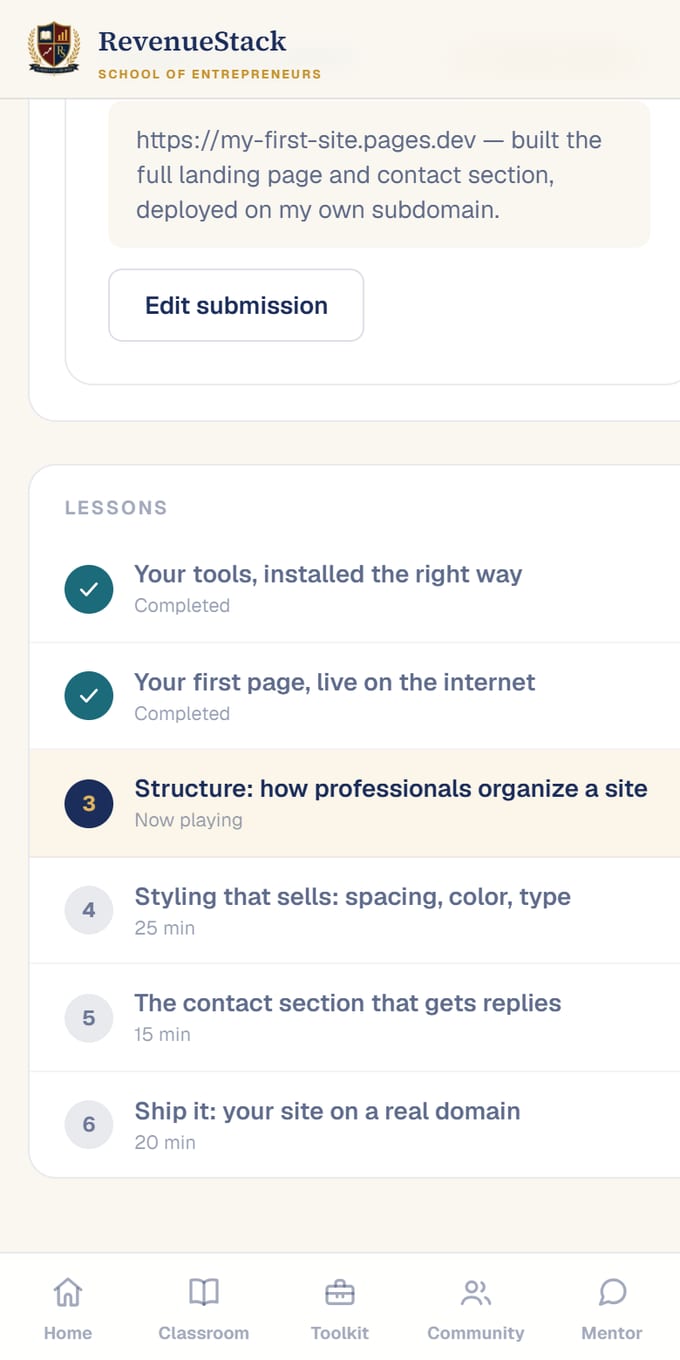
Real review
You build, you submit, a person approves it to client standard.
A school, not a course
Real client work, and a mentor until you get paid
Real code, not page builders
Skills template users can't compete with
A full school year
Nine months to learn, build and get paid
This school does one thing: it builds entrepreneurs. You walk out with a client list no employer can lay you off from — built on real work a mentor reviewed, and proved by a certificate anyone can verify. Where CEOs are born.
How the school works
Watching teaches nothing the market pays for. Here every module ends in real work, and a person decides whether it is good enough to sell.
Your mentor stays until that last step has happened.
The model
Most businesses need capital, employees and an office before they earn anything at all. The one you build here needs none of the three. One person, running what looks like a full team to every client — because a trained operator directing AI now covers what a team used to, on infrastructure that costs nothing to run.
Build. Automate. Own.
Real websites, web apps and systems in clean code — the kind most developers around you cannot produce. Your first builds become your portfolio; your portfolio becomes your sales pitch.
AI drafts the copy and the code — but knowing exactly what to ask for, catching what it gets wrong, and shipping something a client will pay for is the actual skill. You direct the machine instead of being the machine — one person doing the output of a team.
No rented templates, no monthly platform fees, no boss. Everything you build belongs to you or to the client who paid you for it. Your income has no salary cap and no landlord.
Every tool in the stack is introduced inside the course — free versions first. Your one real bill is your AI builder, about $20 a month. Your margin on the first project is close to 100%, and clients happily pay real money for work that costs you almost nothing to run.
There isn't one. The same one-person model scales from your first small project to your first $10,000 month — no employees to pay, no office to rent, no investors to answer to. Profit from the first client onward.
What the work pays
Not a promise of what you will earn — what the market already pays for the work you learn here, at each stage of it.
First: your first paid job
$2,500 – $10,000
for a small-business website built freelance; $10,000–50,000 once it's a custom corporate build, and maintenance retainers add $100–500 a month on top. US freelance developers bill $50–250 an hour. Every one of them started without a client.
Then: recurring work
$5,000 – $15,000
per AI automation workflow. Enterprise suites run $50,000–200,000+ — and they bill again every month they keep running.
Then: bigger builds
$25,000 – $100,000+
for custom web apps, CRMs and client portals. That is the agency rate — you get there with a portfolio behind you, not on week two.
Then: you own the asset
~$484,000
the average asking price for a software product on Acquire.com, on about $203,000 of revenue. Small products at $300–500/month sell for $3,000–5,000. Build it once, sell it, or keep it.
Your mentor stays with you until that first rung is done — until a client has actually paid you — and then helps you see the rest of the ladder. You do not pitch empty-handed either: from day one you can show a client what the school has already built — this is what we can build for you.
Ranges from published freelance, agency and marketplace pricing, July 2026. What you actually charge depends on your skill, your clients and how hard you sell. Nobody here will promise you a number.
Who this is for
Everyone who walks through this door is aiming at one of these. Pick yours — the program meets you there.
You want to build something of your own.
The tools that used to need a whole team now fit in one laptop. You learn the full stack — build, automate, sell — so your idea never waits for a co-founder, an investor, or anyone's permission.
Sells: the whole product — you build the thing itself instead of paying someone to.
You only know that you need to start.
You don't need more motivation — you need a map and a person. From day one you are assigned a mentor who tells you exactly what to build next, and reviews everything you make until confusion turns into a business. You are not confused because you aren't smart enough. You are confused because nobody has shown you yet.
Whichever one you are, the first step is identical.
Why a mentor changes everything
Think about it. If you had never fried an egg before — nobody showed you, you never watched your mother or your sister do it — ten times out of ten, you would get it wrong. You could try ten more times and still get it wrong, because nobody is there to tell you the pan was too hot.
Now replace the egg with a business. Alone, that is what it looks like: broken attempts nobody corrects, mistakes you cannot see, months lost to what a mentor would have caught in a minute.
Don't let that be you.
Building a business is not easy — nobody honest will tell you it is. But with a mentor who has already built one standing beside you, watching every piece of work you submit, you will be getting it right within your first few tries.
Why free information never turned into income
Everything in this program technically exists somewhere on the internet, free. And yet almost nobody learns it alone — because AI cannot tell you what to build next, cannot review your work, and cannot care whether you show up. Left alone with AI and YouTube, most people spend months going in circles: building the wrong things, in the wrong order, with nobody to say why it isn't working.
Your builder. AI drafts the code and writes the copy fast — but raw AI output is generic, and clients don't pay for generic. Inside the program you learn the real skill: how to prompt it, review it, and shape it into something a client will actually buy. You are the director. AI is the workforce.
Not a video. Not a chatbot. A real person who has already walked the path — assigned to you from day one, and staying with you past the last module until a client has actually paid you — for as long as you keep submitting work. Your mentor tells you what to build next, reviews every piece of work you submit, and then helps you see the bigger picture: what to charge, what to build after that, and how a first client becomes a business.
The map. We already spent the money, made the mistakes and tested what works — the program is what survived. No goose chases, no months lost trying tools just to find the right one, no spending money you don't have to spend.
“You are not confused because you aren't smart enough. You are confused because nobody has shown you yet.”
— the sentence every mentor here works by
From Douala to Dallas — the market is already there.
Two paths
You did everything right — degree, job, loyalty. And the ceiling is still the ceiling: capped raises, layoffs announced on a Tuesday Zoom call, a 401(k) you can touch in forty years. A job is not security anymore; a skill that earns on its own is. Here is the honest comparison.
We won't promise you overnight riches — anyone who does is lying to you. We promise skills that are in demand, taught by people who feed their families with them.
Be honest with yourself
Read this before you buy any course
Most of the industry earns its real money after the course is sold — on the tools, templates and subscriptions it talks you into. None of that happens here, and we can prove it.
They rent you templates instead of teaching you to build them.
Their favourite tool pays them 40% of your subscription. Every month. Forever.
The 'standard' guru tool stack costs more per year than this entire program costs once.
Add up what the typical course funnel signs you up for and keeps you renting. At each tool's own official pricing, it comes to roughly $751 a month — about $9,000 every year, forever.
| The tools gurus rent you | Per month | Per year |
|---|---|---|
| GoHighLevel | $297 | $3,564 |
| ClickFunnels | $97 | $1,164 |
| Kajabi | $179 | $2,148 |
| ActiveCampaign* | $49 | $588 |
| Teachable* | $39 | $468 |
| Webflow | $25 | $300 |
| Kixie* | ~$65 | ~$780 |
| The guru stack, every year, forever | ~$751 | ~$9,000 |
*ActiveCampaign price is at only 1,000 contacts. *Teachable Starter adds a 7.5% fee on every sale you make. *Kixie is per user (quote-based; last published rate). Webflow and ActiveCampaign shown at their cheaper annual-billing rates — pay monthly and the stack costs even more. All prices verified on each tool's official pricing page, July 2026.
Now the same money, spent once
Renting the guru stack
~$9,000/yr
every year, for as long as you stay in business
The full DBP program
$1,497
paid once · a full school year · your one tool bill: your AI builder, about $20/month
Your choice.
Our pledge: no affiliate links, no rented templates, no tool we don't use ourselves on paying clients. When we recommend something, the only person it earns money for is you.
Pricing
Your price for United States
Digital Business Professional · Full program
$1,497
One-time payment · 9 months with your mentor · 21 months of access
The typical guru tool stack rents for ~$9,000 every single year. This is once.
Register free and look through every module before paying anything. You advance by submitting real work — which is exactly why the certificate means something.
Not sure yet?
The 3-Day Website Sprint — 15,000 FCFA
Your own site live in three days — join the full program within 30 days and every franc comes off its price.
Start free
A free account is not a brochure — it is working software. No card, no trial clock, no expiry.
What to charge
Real going rates for websites, apps and AI work — in your market, and every market you could sell into.
Invoice maker
A clean invoice under your own name — print it, save it as a PDF, or email it straight to a client.
Your earnings
Every dollar made against every dollar spent, closed monthly like a real business — because you now run one.
The program turns the tools into a business — when you are ready.
Module 1 is built so that two weeks of consistent practice leaves you able to build and publish a real website — the level basic paid client work requires. It's not magic: the two weeks work if you do.
$1,497, once. Everything is included — every module, your dedicated mentor, all files and templates, and your certificate. No bundles, no upsells, no subscriptions — and the tools you'll run your business on cost about $0 a month.
No. You can watch every lesson and follow along on your phone. A laptop helps as you advance, but you do not need one to start.
Card, bank transfer or Apple Pay, on a secure checkout that runs on this site — you are never handed off to another company's page. Create your free account, pay, and your whole program opens the moment the payment clears.
None at all. Module 0 and Module 1 start from absolute zero and assume you have never written a line of code.
You don't pitch empty-handed. From day one you can walk a client through what the school and your mentors have already built — not as your own work, but as what we can build for them. And because your mentor reviews everything before it ships, a client hiring you is getting supervised work, not a beginner alone. Your own projects join that portfolio as you finish them, until you no longer need ours.
Your mentor does not disappear. They stay with you until you land your first paying client — reviewing your pitches, checking your pricing, and telling you what to fix when a lead goes cold. That holds for as long as you keep submitting work and showing up; it is a commitment to people doing the work, not an open-ended one. After that they help you see the bigger picture: what to charge next, what to build after websites, and how one client turns into a business. Most courses end at the last video. This one ends when you have been paid.
No — and that is deliberate. No page builders, no drag-and-drop templates, no plugins that break every update, no monthly fees just to keep a site alive. You learn to build in clean, modern code on infrastructure that costs nothing to run. Most web developers around you cannot build this way — that is exactly your edge.
Still have a question?
Ask us on WhatsAppThat's not bad news — it's freedom. The skills that build CEOs are learnable, and a mentor stays with you until a client has actually paid you.